Sir Alec Douglas-Home
Conservative 1963 to 1964
Sir Alec Douglas-Home only served as Prime Minister for 363 days but he oversaw the abolition of resale price maintenance and took a tough stance in dealing with the trade unions.
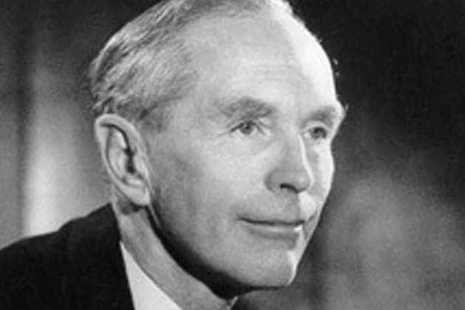
Born
2 July 1903, London
Died
9 October 1995, Berwickshire
Dates in office
1963 to 1964
Political party
Conservative
Biography
Sir Alec Douglas-Home was born in Mayfair, London, into an aristocratic family. He attended Eton College followed by Oxford University, where he graduated with a third class BA in Modern History. He also played first class cricket for prominent clubs.
In 1931, he entered Parliament as a Scottish Unionist Party (combined with the Conservative Party in 1965) MP for Lanark. As Parliamentary Private Secretary to Prime Minister Neville Chamberlain from 1937 to 1939, he attended the Munich Conference in 1938, though he was not tainted by the fallout.
Severe illness during the Second World War prevented him from active participation, and he lost his seat in the 1945 General Election.
After his father passed away, he became the 14th Earl of Home and took a seat in the House of Lords. He served as Commonwealth Secretary during the Suez Crisis of 1956, in addition to holding the positions of Leader of the House of Lords and Lord President of the Council.
In 1959, the Conservative Party under Harold Macmillan won the General Election. The following year, he was appointed Foreign Secretary. He remained in the role until 18 October 1963, when Macmillan suddenly resigned due to a prostate condition that was exacerbated by the Profumo Affair.
Douglas-Home’s emergence as the new leader of the Conservative Party attracted some claims that Macmillan had worked to make sure ‘The Magic Circle’ deny Rab Butler the leadership, but Reginald Maudling had also been a strong candidate. Even so, he rejected his peerage on 23 October 1963 and became Sir Alec Douglas-Home. On 7 November he contested and won the constituency of Kinross and West Perthshire – but for the 2 weeks in between he was a Prime Minister who belonged to neither the House of Commons nor the House of Lords.
He did not originally seek the position of Prime Minister, but was widely respected by his party and its future leaders. By the time he took over, the Conservative Party had been in office for 12 years and had contested 3 elections; Sir Alec Douglas-Home was the fourth party leader during the period. In contrast, Harold Wilson was a fearful leader of the Labour Party. Despite this, Sir Alec Douglas-Home concentrated heavily on winning the next election and as a result he narrowed the Labour lead in the opinion polls.
As his biographer D R Thorpe notes, the legacy of his government was the abolition of resale price maintenance, which enabled the cut price stickers on goods we see today. The reform – led by President of the Board of Trade Edward Heath – faced opposition within the party, but Sir Alec Douglas-Home held firm and the bill was eventually passed.
He also took a tough stance in dealing with the trade unions.
During Sir Alec Douglas-Home’s premiership, American President John F Kennedy was assassinated, and relations with Kennedy’s successor Lyndon B Johnson deteriorated after the sale of British Leyland buses to Cuba. Macmillan famously described Sir Alec Douglas-Home to the queen as ‘steel painted as wood’.
Sir Alec Douglas-Home was an unexpected Prime Minister and served for only 363 days, the second shortest premiership in the 20th century – but he pushed his plan as he did not see any reason why the Conservative Party would not win a fourth term. The general election held on 15 October 1964 saw Wilson win a 4-seat majority.
Despite defeat, he went on to serve as Foreign Secretary throughout Edward Heath’s premiership from 1970 to 1974.